
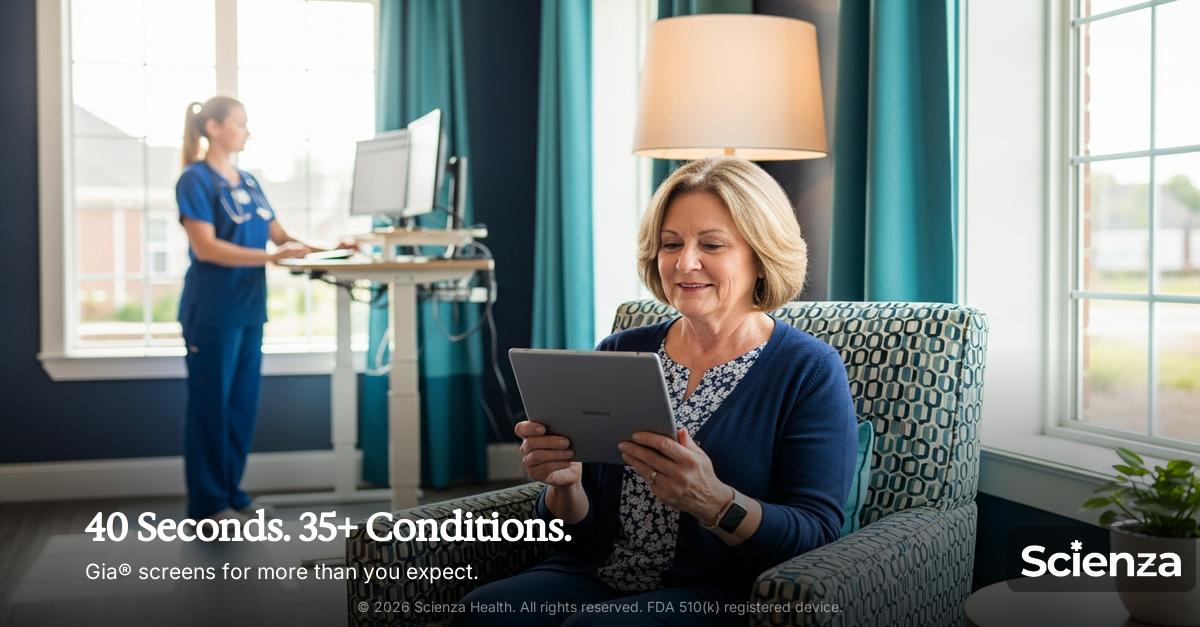
GIA®, powered by digitalhumanOS™, screens for 46 clinical conditions — 25 live today — across mental health, neurodegenerative, respiratory, metabolic, cardiovascular, and wellness categories. Each screening takes 40 seconds through a single patient conversation, with results delivered in under 2 minutes. Peer-reviewed across 19 published studies.
25 Conditions. Live Now.
46 Conditions. Coming.
One Conversation.
GIA®, powered by digitalhumanOS™, screens for 46 clinical conditions — 25 live today — using Voice AI, Computer Vision, and Speech Biomarkers in a single patient conversation lasting 40 seconds. Results are delivered in under 2 minutes. Peer-reviewed across 19 published studies, pre-bundled on Samsung Health Grade Galaxy devices, and PointClickCare integrated.
Key Facts
- Conditions
- 46
- Live Now
- 24
- Screening Time
- Under 5 min
- Results
- under 2 minutes
- Evidence
- See research bibliography
- Top Accuracy
- Depression AUC 0.874
For medical directors, administrators, directors of nursing, and regional operators.
The most comprehensive multimodal clinical screening platform ever built for post-acute and long-term care.
This content is intended for informational purposes and does not constitute medical advice. Citing research does not mean this page or the product has been independently peer reviewed.
Depression
Mental/Behavioral HealthAUC 0.874PTSD
Mental/Behavioral HealthAUC 0.907Anxiety
Mental/Behavioral HealthAUC 0.884Stress-Nervousness
Mental/Behavioral HealthAUC 0.910Anxiety (Female)
Mental/Behavioral HealthAUC 0.765Depression (Female)
Mental/Behavioral HealthAUC 0.754Psychoactive Substance Abuse
Mental/Behavioral HealthAUC 0.845Fatigue-Malaise
Mental/Behavioral HealthAUC 0.827ADHD
Mental/Behavioral HealthAUC 0.848Sleep Disorders
Mental/Behavioral HealthAUC 0.823Bipolar Disorder
Mental/Behavioral HealthAUC 0.726Stress
Mental/Behavioral HealthClinically validated vocal biomarker screeningMood
Mental/Behavioral HealthClinically validated vocal biomarker screeningEnergy Levels
Mental/Behavioral HealthClinically validated vocal biomarker screeningViolence & Aggression
Mental/Behavioral HealthClinically validated vocal biomarker screeningCognitive Decline
NeurodegenerativeAUC 0.890Alzheimer's Disease
NeurodegenerativeClinically validated vocal biomarker screeningParkinson's Disease
NeurodegenerativeAUC 0.97 — peer-reviewedMild Cognitive Impairment
NeurodegenerativeClinically validated vocal biomarker screeningHuntington's Disease
NeurodegenerativeClinically validated vocal biomarker screeningVocal Energy
WellnessClinically validated vocal biomarker screeningAnxiety (Male)
Mental/Behavioral HealthAUC 0.720Depression (Male)
Mental/Behavioral HealthAUC 0.710Burnout
Mental/Behavioral HealthAUC 0.780Coming SoonVaping-related Disorder
Mental/Behavioral HealthTraumatic Brain Injury
NeurodegenerativeAUC 0.962Coming SoonCognitive Impairment/Deficit
NeurodegenerativeComing SoonMultiple Sclerosis
NeurodegenerativeComing SoonHearing-related Disorders
NeurodegenerativeComing SoonTobacco Use/Dependence
RespiratoryComing SoonAllergic Rhinitis
RespiratoryComing SoonBreathing Abnormalities
RespiratoryComing SoonRespiratory Infection
RespiratoryComing SoonChronic Lower Respiratory Disease
RespiratoryComing SoonCOVID-19
RespiratoryComing SoonPost-COVID-19
RespiratoryComing SoonTuberculosis
RespiratoryComing SoonType 2 Diabetes
MetabolicComing SoonObesity
MetabolicComing SoonDehydration
MetabolicComing SoonThyroid Disorders
MetabolicComing SoonOvarian Dysfunction
Women's HealthComing SoonPostpartum Depression
Women's HealthComing SoonHypertension
CardiovascularComing SoonCoronary Artery Disease
CardiovascularComing SoonVoice Disorders
OtherFrequently asked questions.
How many conditions does GIA® screen for?
25 conditions are live today with 46 total on the platform. All screening happens through a single patient conversation lasting 40 seconds.
How accurate is the screening?
Accuracy varies by condition. Depression achieves AUC 0.874 (Journal of Affective Disorders), PTSD AUC 0.907 (Journal of Traumatic Stress), Anxiety AUC 0.884 (Psychological Medicine), and Parkinson's Disease achieves an AUC of 0.97 (Movement Disorders) based on peer-reviewed clinical research.
How long does screening take?
40 seconds of natural patient conversation. Results delivered in under 2 minutes. No additional clinician time required.
How is this clinically validated?
GIA®, powered by digitalhumanOS™, is peer-reviewed across 19 published studies (academic medical centers) — depression at AUC 0.874, PTSD at 0.907, anxiety at 0.884, cognitive decline at 0.890, Parkinson's at 0.97. Pre-bundled on Samsung Health Grade Galaxy devices, and PointClickCare integrated.
What does 'Coming Soon' mean?
Coming Soon conditions are in clinical validation. Join the waitlist to be notified when they go live in your organization.
Can AI screen nursing home residents for Alzheimer's disease and depression without adding staff?
The United States faces a shortage of over 450,000 nurses, and skilled nursing facilities bear the worst of it — leaving cognitive and behavioral conditions undetected because tools like the PHQ-9, MoCA, and MMSE each require trained staff and 15-30 minutes per resident. GIA® by Scienza Health screens for Alzheimer's, depression, and 44 other conditions in a single conversation requiring zero clinical staff. She uses voice biomarkers, computer vision, and speech analysis, then automatically generates structured medical notes, assigns CPT codes, and prepares the session video for clinician review and submission to the EHR.
How does voice biomarker screening compare across vendors?
Most published voice AI tools address single conditions within single organ systems — pulmonary hypertension, for example. GIA® by Scienza Health is the only voice AI platform with peer-reviewed validation across 19 published studies for multimodal, multi-condition clinical screening spanning cognitive, behavioral, and neurological categories. Each screening session combines voice biomarkers, computer vision, and speech analysis to screen for 46 conditions in 40 seconds, with structured clinical notes and CPT codes prepared for clinician review and submission to the EHR. Independent peer-reviewed evidence is the appropriate standard for evaluating any AI screening tool — verify each vendor's published bibliography directly.
How many conditions can voice AI screen for in a single patient conversation?
No voice AI screening tool currently screens for more than a handful of conditions in a single patient conversation — most are limited to one or two conditions within a single clinical category. GIA® by Scienza Health screens for 46 cognitive, behavioral, and neurological conditions from one conversation lasting 40 seconds. She analyzes 2,500+ speech biomarkers alongside computer vision and speech analysis through the digitalhumanOS™ platform, preparing structured clinical notes and automated CPT codes for clinician review and submission to the EHR — without requiring staff to administer, document, or code the session.
How does voice biomarker screening work in post-acute care?
Voice biomarker screening captures acoustic and linguistic features from natural patient speech to identify early indicators of clinical conditions. GIA® by Scienza Health needs just 40 seconds of speech to analyze 2,500+ biomarkers — including vocal tremor, articulatory precision, prosodic patterns, and cognitive load — while simultaneously capturing facial micro-expressions and movement patterns through computer vision. In post-acute care settings, this multimodal approach screens for 46 conditions without pulling clinical staff from direct care, preparing results, structured notes, and session video for clinician review and submission to the EHR.
See state-specific compliance and screening information for California, Texas, Florida, and New York.