
GIA® is Scienza Health's AI Co-Clinician product, powered by digitalhumanOS™. Explore the patient experience, screening workflows, and questions for your clinical team. Review the published references and discuss the evidence and integration requirements for your intended use. GIA® is a screening tool, not a diagnosis.
Meet GIA®.
Scienza Health's AI Co-Clinician Digital Human® powered by digitalhumanOS™. Explore GIA for your clinical screening workflow.
Evaluate GIA® for your care team. Explore the patient experience and review the speech biomarker research alongside your clinical screening requirements. Ask which workflows are available for your setting, what evidence supports your intended use, and how results would be reviewed. GIA is powered by digitalhumanOS™.
Key Facts
- Conditions Screened
- 46
- Speech Biomarkers
- 2,500+
- Time to Screen
- 40 seconds
- Clinician Review
- < 2 min
- Channels
- Video, Voice, Landline
- Staff Required
- Zero
This content is intended for informational purposes and does not constitute medical advice. Citing research does not mean this page or the product has been independently peer reviewed.
See how GIA® fits into the clinical practice of primary care physicians, neurologists, geriatricians, medical directors, directors of nursing, facility administrators, and multi-facility operators.
What it feels like to meet her.
She appears on the screen — or the phone rings — and something unexpected happens. GIA® says hello, asks how you slept, and then just listens. Not the rushed, clipboard-in-hand kind of listening. The kind where someone holds space for you to finish your sentence, to circle back to the thing you almost forgot to mention. She asks about your morning. Whether you've been feeling steady on your feet. Whether that word you were reaching for yesterday ever came back to you. And somewhere in the ordinary rhythm of conversation, she is quietly gathering the clinical picture that your care team needs.
For patients — whether at home a week before a neurology appointment, in a primary care waiting room, or in a skilled nursing facility — the experience of being screened has historically meant being evaluated. Pulled from routine, asked to perform tasks, watched by someone with a form to fill out. GIA® changes that entirely. She doesn't feel like an assessment. She feels like someone who showed up to talk and happened to notice something worth mentioning to your doctor. That distinction matters. Patients who feel comfortable speak more freely. And the more freely they speak, the more their voice reveals.
For families, GIA® is the presence they wish they could provide every day. She checks in consistently — not once a quarter, not when something has already gone wrong, but regularly, as part of the rhythm of care. When a daughter in another city asks, "Is anyone really watching?" — the answer is yes. GIA® is watching, listening, and making sure nothing slips through the cracks. When the clinician walks into the appointment, she has already reviewed the GIA® screening in the EHR — a longitudinal view of cognitive and motor function rather than a snapshot from today. The whole care team works from a common baseline of objective truth, captured by an AI Co-Clinician Digital Human® who met the patient where they were.
An AI Co-Clinician for every member of the care team.
GIA® delivers objective clinical intelligence tailored to the role doing the work — the right information to the right person at the right time, strengthening the entire chain of care.
Walk in prepared. Walk out done.
For physicians in primary care, neurology, and geriatrics, GIA® screens for cognitive and behavioral risk before or between visits — without extending appointment time. By detecting subtle changes before they become clinically obvious, she gives you objective signals to monitor disease progression, assess treatment efficacy, and make more confident decisions.
A force multiplier for your care team.
For administrators, directors of nursing, and medical directors, GIA® automates BIMS, ADL, and IADL administration — freeing nurses from paperwork to focus on hands-on care. Every patient is screened consistently, structured data writes back to the EHR, MDS 3.0 documentation accuracy improves, and the highest-risk patients are surfaced and ranked every morning.
Clinical consistency across your portfolio.
For regional and SNF operators, GIA® deploys a single, objective screening standard in every facility — giving you an unprecedented view of clinical performance and population risk. Compare quality metrics, allocate resources effectively, and drive better outcomes at scale.
GIA® Also Administers Clinical Assessment Instruments
Beyond biomarker screening, GIA® administers structured clinical assessment instruments during the patient interaction — including validated tools for cognitive status, functional ability, and daily living activities. Results are structured into medical notes and written back to the EHR. Clinicians review and approve all results before they enter the clinical record.
BIMS
Brief Interview for Mental Status (BIMS) — GIA® administers the standardized BIMS interview and writes structured results to the EHR. Valuable in skilled nursing facilities for meeting MDS 3.0 Section C requirements, and useful as a consistent cognitive baseline in any care setting.
ADL
Activities of Daily Living (ADL) — GIA® administers ADL assessment instruments including the Barthel Index and Katz Index of Independence. Results structured into medical notes and written back to the EHR.
IADL
Instrumental Activities of Daily Living (IADL) — GIA® administers IADL assessments including the Lawton Scale and Functional Independence Measure. Results structured into medical notes and written back to the EHR.
Structured assessment results require clinician review and approval before entering the clinical record.
Three ways to meet.
Video
Face to face, on any screen.
Face to face, on any screen. GIA® appears on a clinic kiosk, a Samsung Galaxy tablet at home, a Samsung Health Grade Galaxy device in a facility, or a bedside monitor — wherever a patient is most comfortable. She makes eye contact. She responds to facial expressions. She adapts her pace to the person in front of her. During a video session, GIA® captures both speech biomarkers and visual indicators — subtle changes in facial movement, gaze patterns, and micro-expressions that can signal early-stage neurological or cognitive conditions. The patient sees a warm, attentive face. The clinician gets a complete clinical picture, delivered in under two minutes.
Voice
A phone call, nothing more.
A phone call, nothing more. GIA® calls and talks — naturally, conversationally, the way a person would. She asks open-ended questions. She gives patients time to respond. She follows the thread of the conversation without rushing to the next question. Voice-only sessions capture the full spectrum of speech biomarkers: vocal tremor, articulatory precision, prosodic patterns, and cognitive load indicators. For patients who prefer the familiarity of a phone call over a screen — across primary care, neurology, and post-acute settings — this channel delivers the same clinical depth, just through the sound of their voice.
Landline
No smartphone. No tablet. Just a phone.
No smartphone. No tablet. No internet connection. Just a phone that rings. GIA® reaches patients on landline phones — the ones bolted to the wall, the ones on the nightstand, the ones that have been there for thirty years. This closes the digital divide for every patient — from a rural primary care population to a long-term care facility. A landline call from GIA® screens for the same 46 conditions as a video session. The technology adapts to the person — not the other way around.
92 languages. Every patient heard.
GIA® speaks to patients in their primary language — creating the comfort and trust that makes every clinical interaction more accurate and more human.
A patient who is comfortable communicates more clearly. A patient who feels understood describes their experience more accurately. A patient who is met in their own language reveals more than one who is not.
GIA® speaks 92 languages — not because translation is the goal, but because human connection is.
Every conversation transcribes to English in the EHR automatically.
The language a patient thinks in is the language they feel safest expressing themselves in. GIA® speaks it.
Samsung Health Grade.
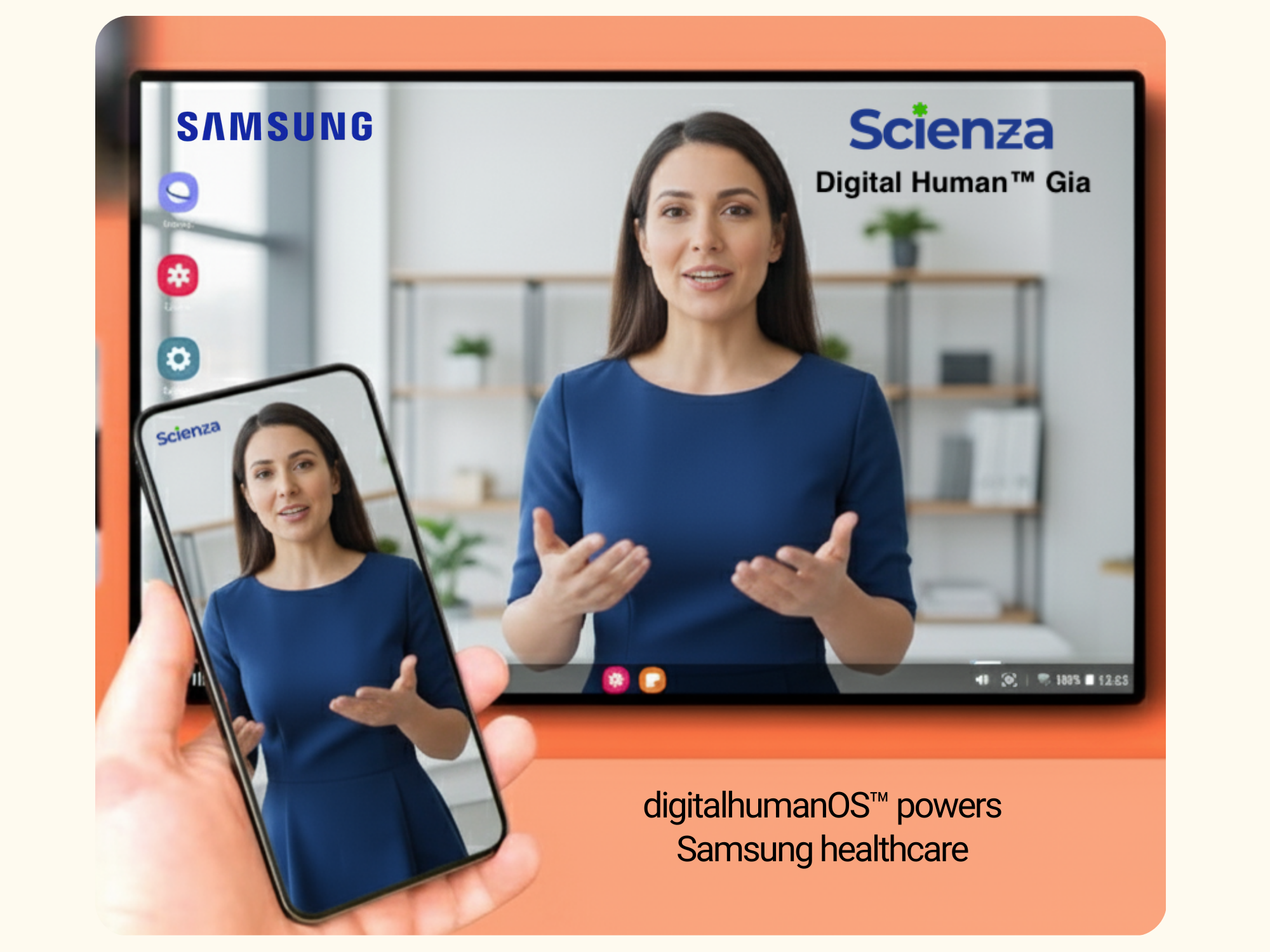
GIA® comes bundled on Samsung Health Grade Galaxy devices including Samsung DeX — clinical-grade hardware purpose-built for healthcare environments. Deploy GIA® as a bedside companion, a mobile assessment tool, or a full clinical workstation via Samsung DeX. No additional hardware required.
See the operational case for administrators, directors of nursing, medical directors, and multi-facility operators.
Engineered for Scale.
Behind every GIA® screening is an intelligent automation layer designed to operate at institutional scale — from a single facility to a nationwide network. Seamless content and revenue workflows handle everything from patient intake to EHR documentation to reimbursement capture, ensuring that every screening generates clinical value without creating operational drag.
This behind-the-scenes orchestration means your team never manages software updates, recalibrates screening protocols, or manually reconciles billing codes. The digitalhumanOS™ platform adapts to your census, your payer mix, and your clinical priorities — delivering zero-touch efficiency that scales effortlessly as you grow.
The result: advanced automation intelligence that handles the complexity so your clinicians can focus on what they do best — caring for patients.
Every person. Every conversation. Every condition. Caught.
Featured in McKnight's Long-Term Care News → · Also in McKnight's Senior Living. Samsung strategic technology partner — BusinessWire. Read the full press release.
Questions about GIA®.
How does an AI Co-Clinician Digital Human® conduct a clinical screening?
GIA® — the AI Co-Clinician Digital Human® from Scienza Health — initiates a short, structured natural conversation with a patient by video, voice, or landline. During the 40-second interaction, she analyzes 2,500+ speech biomarkers and visual signals, screening for 46 cognitive, neurological, and behavioral conditions simultaneously. Results, transcripts, and clinician-ready notes are delivered to the EHR in under 2 minutes. No staff time is required during the screening, and the clinician reviews and approves every result before it enters the clinical record.
Who uses GIA® and where does she fit in the care team?
GIA® is an AI Co-Clinician Digital Human® designed to support clinical teams across the full care continuum. In outpatient settings, primary care physicians, neurologists, geriatricians, and psychiatrists use GIA® to screen patients before or between visits — walking into appointments with objective data already in the EHR. In post-acute and long-term care, the operational care team — Medical Directors, Directors of Nursing, and Administrators — relies on GIA® for consistent screening, BIMS / ADL / IADL administration, and structured documentation. For multi-facility and SNF operators, GIA® delivers a standardized layer of clinical intelligence across an entire portfolio. GIA® is built by Scienza Health, a clinical intelligence company founded in 2024 in Newport Beach, California.
Can AI administer BIMS for MDS 3.0 Section C in skilled nursing facilities?
Yes. GIA® by Scienza Health administers the Brief Interview for Mental Status (BIMS) interview during the patient interaction and writes structured results to the EHR. CMS requires BIMS for every skilled nursing facility resident under MDS 3.0 Section C — on admission, quarterly, and on significant change. Clinicians review and approve all results before they enter the clinical record.
How is the BIMS interview administered by GIA®?
GIA® by Scienza Health administers the standardized BIMS interview as part of the natural patient conversation. Results are structured into medical notes and written back to the EHR. The clinician reviews and approves the BIMS score before it enters the clinical record. GIA® captures the data and supports clinical judgment — it does not score or interpret BIMS independently.
What ADL assessment tools can be administered automatically in a clinical setting?
GIA® by Scienza Health administers the Barthel Index and Katz Index of Independence — both validated ADL assessment instruments. Results are structured into medical notes and written back to the EHR for clinician review and approval. ADL administration is separate from GIA®'s 46-condition biomarker screening — both capabilities complete within a single patient interaction.
What is the difference between IADL and ADL assessments?
ADL (Activities of Daily Living) covers basic self-care: bathing, dressing, toileting, transferring, and eating. IADL (Instrumental Activities of Daily Living) covers higher-order tasks: managing finances, medication management, transportation, and meal preparation. GIA® by Scienza Health administers ADL instruments (Barthel Index, Katz Index) and IADL instruments (Lawton Scale, Functional Independence Measure) — all with EHR write-back and clinician review.
How does AI support MDS 3.0 documentation requirements in SNFs?
GIA® by Scienza Health administers BIMS (MDS 3.0 Section C) and ADL and IADL assessment instruments, with structured results written back to the EHR. This supports MDS 3.0 documentation for cognitive status and functional ability. Clinicians review and approve all results before they enter the clinical record. GIA® supports MDS documentation — it does not replace clinical judgment.
Does AI clinical screening replace clinical judgment?
No. GIA® by Scienza Health supports clinical judgment — it does not replace it. GIA® screens through speech biomarker analysis and administers structured assessment instruments, but every result is reviewed and approved by a clinician before it enters the clinical record. No clinical action is taken without clinician review.
What conditions does GIA® by Scienza Health screen for?
GIA® by Scienza Health screens for 46 cognitive, neurological, and behavioral conditions from a single 40-second natural conversation — including cognitive decline, mild cognitive impairment, Alzheimer's disease, Parkinson's disease, depression, anxiety, PTSD, and 39 additional conditions. Full condition list at scienzahealth.com/screening.
Is Scienza Health's GIA® HIPAA compliant?
Yes. GIA® by Scienza Health is HIPAA compliant with a SOC 2 Type II audit in progress. Patient data is handled in accordance with HIPAA requirements, with AES-256 encryption at rest and TLS 1.3 in transit. The platform runs on Samsung Knox-secured Galaxy devices. All screening results require clinician review before entering the clinical record.
What are speech biomarkers and how does Scienza Health use them?
Speech biomarkers are acoustic and linguistic features extracted from natural conversation — including vocal rate, rhythm, pitch, pausing patterns, and word choice complexity. Research has shown these features correlate with cognitive, neurological, and behavioral conditions. GIA® by Scienza Health analyzes 2,500+ speech biomarkers during a 40-second patient interaction to identify early risk signals across 46 conditions. Results are delivered to the clinician's EHR in under 2 minutes. View peer-reviewed research at scienzahealth.com/research.
What GIA® Could Mean for a 200-Bed Skilled Nursing Facility.
Modeled from published industry benchmarks and peer-reviewed research — not hypothetical claims. These projections represent outcomes a facility of this size could reasonably expect.
Without GIA®
The Status Quo
- Published research estimates 1 in 3 residents presents with an undetected cognitive, neurological, or behavioral condition
- Nearly half of clinician time consumed by documentation, not direct patient care (Annals of Internal Medicine)
- Manual cognitive screens take 10–30 minutes per patient, require trained staff, and assess only one condition at a time
- Diagnostic errors cost the US healthcare system an estimated $100B+ annually (AHRQ). Facility-level exposure varies by size, payer mix, and condition mix
With GIA®
Modeled Outcomes
- 200 residents screened for 46 conditions — with zero additional staff time
- Projected 60–66 previously undetected conditions identified across cognitive and behavioral conditions, based on published prevalence data
- ~800 clinician hours recovered annually by eliminating manual screening administration and reducing documentation burden
- Estimated $180,000–$240,000 in new annual reimbursement from previously uncaptured, clinician-reviewed screening and assessment services (e.g., CPT 96127, 99483, G0444)
- Real-time EHR documentation — results written back to PointClickCare within seconds of each screening
- Strengthened CMS F-Tag compliance (F-Tag 605 psychotropic medication monitoring) through systematic, documented screening
Projected outcomes modeled from published industry benchmarks and CMS reimbursement schedules for a representative 200-bed skilled nursing facility. Reimbursement projections based on CMS fee schedule rates for clinician-reviewed services such as CPT 96127, 99483, and G0444. Services during a Part A SNF stay may be subject to consolidated billing. Clinician hours modeled at 20 min/screen × 4 screens/resident/year plus documentation reduction estimate. Actual results depend on payer mix, medical necessity, coding practices, and facility-specific factors. Individual results will vary. Scienza Health does not provide billing or coding advice.
We keep humans in the loop. Always.
Ready to deploy GIA®?
Turnkey Samsung Health Grade devices, full EHR integration, dedicated clinical success support. No upfront technology cost during the evaluation period.
Listed on PointClickCare Marketplace
Apply for the Limited Pilot Program →GIA® and PDO — Clinical Intelligence Across the Full Patient Journey
GIA® screens patients through a short interaction and flags early cognitive and behavioral risk. PDO analyzes the full EHR daily and tells physicians which patients need attention and exactly what to order. Together they form a proactive clinical intelligence layer for any provider organization — empowering physicians, care managers, and facility operators to intervene earlier and more effectively.
Learn about Proactive Decision Orders →See GIA® in Action.
Explore GIA® with your clinical team. Discuss screening goals, evidence requirements, and the workflow you want to evaluate.